Table of contents
The landscape of garden visualization tools
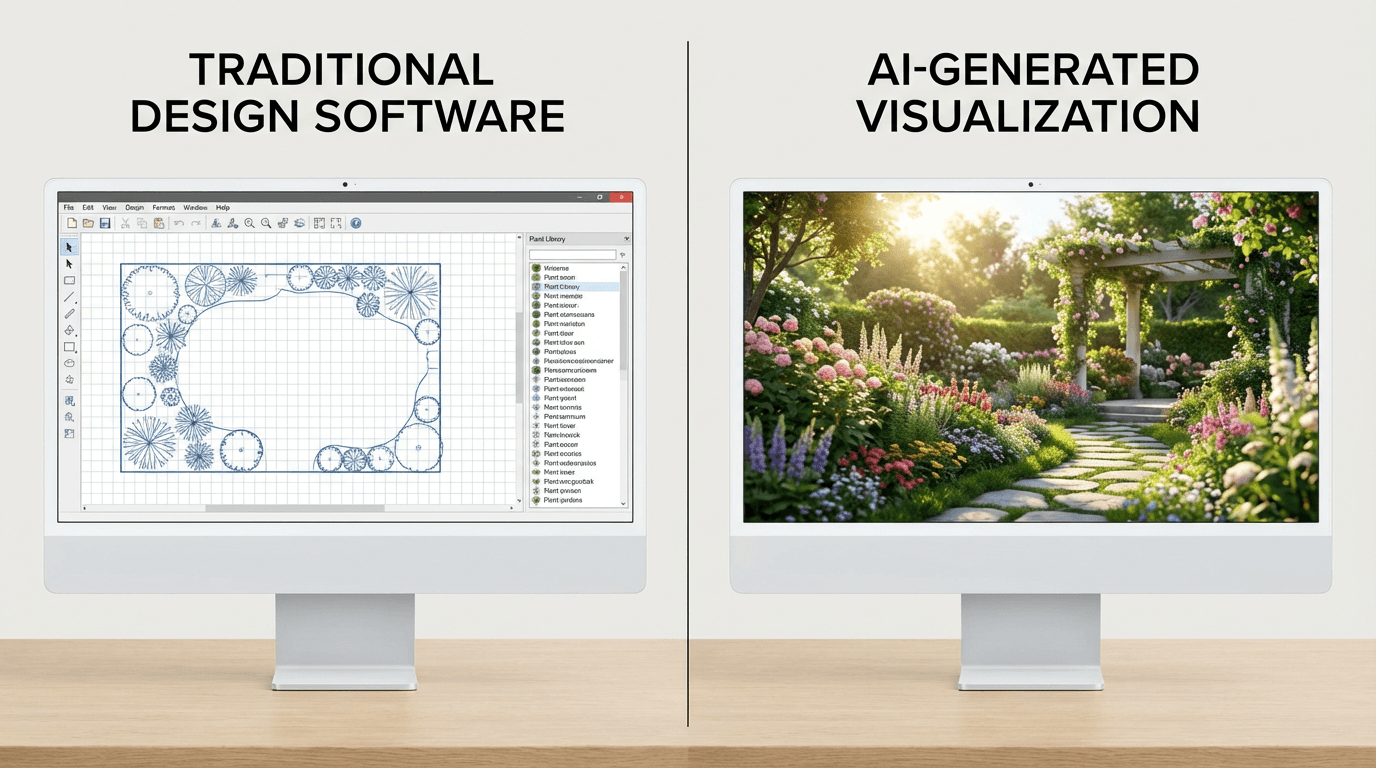
To visualize a garden project, two major tool categories compete: traditional landscaping software and generative AI visualization tools. Each approach has its strengths and limitations, and the best choice depends on your profile and objectives.
Traditional software like SketchUp, Realtime Landscaping Architect, or iScape offers precise 3D modeling. AI tools like Garden Preview generate photorealistic visualizations from a simple photo.
Traditional software: precision and control
3D landscaping software enables detailed modeling of every garden element. You control exact dimensions, materials, plant species, and orientation. The result is a technical plan usable by a contractor.
In return, these programs demand significant learning. Count 20 to 100 training hours to master a tool like SketchUp with landscaping extensions. Professional license costs range from 300 to 2,000 euros per year.
AI visualization: speed and accessibility
The AI approach inverts the paradigm. Instead of modeling each element, you start from a real photo of your garden and the AI generates a visualization with the desired landscaping. The process takes 30 seconds instead of several hours.
Accessibility is the major strength. No training required, intuitive interface, immediate result. The cost per visualization is minimal compared to software licenses or professional fees.
Rendering quality: AI advantage
Paradoxically, AI rendering is often more realistic than traditional 3D software. Generative AI produces photorealistic images that naturally integrate light, shadows, and textures. 3D software requires considerable texturing and lighting work to approach this level of realism.
However, AI offers less control over precise details. If you need exact dimensions or a technical plan, 3D software remains essential.
Which tool for which use?
For a homeowner exploring ideas: AI is the ideal choice. Fast, affordable, and no learning curve. For a landscaper in the prospecting phase: AI accelerates client presentations. For a landscaper in the execution phase: 3D software provides the necessary technical plans.
The best strategy is often to combine both approaches: AI for the design and client validation phase, 3D software for the technical execution phase.
Comparison summary
In summary, AI excels in speed (30 seconds vs several hours), accessibility (no training vs 20-100 hours), visual realism, and cost per project. 3D software excels in dimensional precision, detail control, usable technical plans, and advanced customization.
The choice is not exclusive. Both tools complement each other perfectly in a modern professional workflow.